
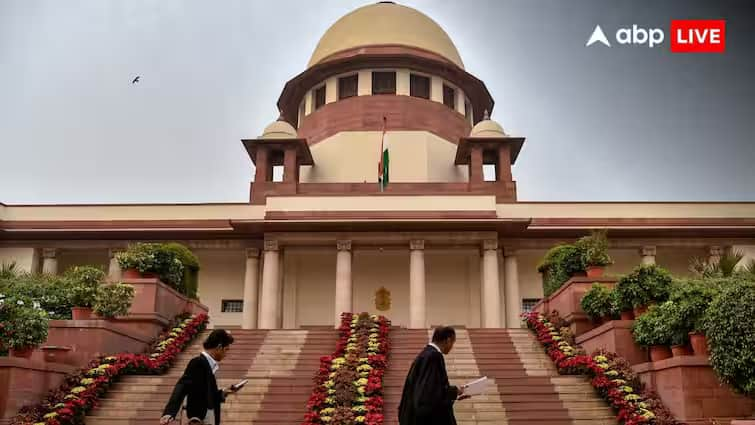

SC On Places Of Worship Act: The Supreme Court will hear petitions challenging the constitutionality of the Places of Worship Act 1991 on December 12, 2023. The court has constituted a special bench regarding this matter, which includes Chief Justice of India Sanjiv Khanna, Justice Sanjay Kumar and Justice KV Vishwanathan. The hearing of this case will be at 3:30 pm.
The Places of Worship Act has been challenged by Hindu parties, claiming that it violates the rights to practice religion and restitution of religious property under Articles 25 and 26 of the Constitution. The petitioners argue that this law prevents religious communities from protecting the rights of their places of worship and is against the basic structure of the Constitution.
Main Petitioner:
1. Ashwini Upadhyay (BJP leader)
2. Subramanian Swamy (Former Union Minister)
3. Kumari Krishna Priya of Kashi royal family
4. World Gentlemen Priest Federation
Central government’s stance
Last year, during the hearing on the petitions challenging the Places of Worship Act, the Supreme Court had given time to the Center to reply on July 11, 2023. After which more time was sought from the Central Government to file its reply before the bench headed by the then Chief Justice Chandrachud of the Supreme Court. The Supreme Court has already given time to the Central Government several times to reply.
Although the Central Government is a party to these petitions, it has not yet filed its official reply. Solicitor General Tushar Mehta had expressed his desire to file a reply to the court, but despite the passage of the deadline of October 31, 2023, no reply was given.
Petitions filed in the Supreme Court
The lead petition in this set of cases has been filed by Bharatiya Janata Party (BJP) leader and lawyer Ashwini Kumar Upadhyay, who has alleged that the 1991 law violates Article 25 of the Constitution (right to practice and propagate religion) and Article 25 of the Constitution. Violates Article 26 (right to manage religious affairs), as well as being discriminatory by preventing religious communities from going to courts to restore their places of worship. He also questioned the power of the Center to make such laws.
Urge to extend relaxation to Kashi Vishwanath and Mathura temples
Other petitioners include Vishwa Bhadra Pujari Purohit Mahasangh and BJP leader and former Union Minister Subramanian Swamy. Swamy, through advocate Vishnu Shankar Jain, has questioned the 1991 law on the grounds that the Act denies judicial review, which is part of the basic structure of the Constitution, as it empowers citizens to reclaim their rights. Prevents filing of lawsuits against temples which were once destroyed by Muslim rulers. On the other hand, Swamy urged the court to extend the exemption given for Ram Janmabhoomi-Babri Masjid land to Kashi Vishwanath and Mathura temples.
Claim of Krishna Priya of Kashi royal family
Kumari Krishna Priya of the Kashi royal family has also filed an application, claiming that the 1991 law is discriminatory because it exempts the Ram Janmabhoomi, but not the Kashi temple. The Idgah in Mathura is next to the Shri Krishna Janmabhoomi site, where Lord Krishna is believed to have been born, while the lawsuit in the Gyanvapi case claims the mosque to be part of the Kashi Vishwanath temple.
Muslim favor and support
The Muslim side has also approached the apex court seeking implementation of the 1991 law and is part of the current batch of cases to be heard on Tuesday. This includes the petition of Jamiat Ulama-e-Hind and an application filed by All India Muslim Personal Law Board (AIMPLB). Last month, the Gyanvapi Masjid Committee had filed an application to intervene in the proceedings. Its application is yet to be heard.
Stand of Jamiat Ulama-e-Hind and AIMPLB
Jamiat Ulama-e-Hind and All India Muslim Personal Law Board (AIMPLB) have demanded implementation of the 1991 Act. They argue that this law is necessary to maintain communal harmony and prevent mosques from becoming the subject of trivial disputes. A request has been made to dismiss the cases against Gyanvapi, Mathura, and other mosques. According to the Muslim side, these cases are aimed at targeting religious minorities and are a threat to the secular nature of the country.
AIMPLB issued a statement on November 28 appealing to the Supreme Court to take suo motu cognizance of the case and direct lower courts not to entertain such cases. AIMPLB national spokesperson SQR Ilyas said, “Such claims (against mosques) are a blatant mockery of the law and the Constitution, especially in view of the existence of the Places of Worship Act 1991. The objective (of the law) was clear to protect mosques after the Babri Masjid case.” Or to prevent further targeting of other religious places.”
What is the Places of Worship Act 1991?
In 1991, the government of the then Prime Minister PV Narasimha Rao brought the Places of Worship Act, 1991. It is also known as the Places of Worship Act. According to this Act, any religious place that came into existence before August 15, 1947 cannot be converted into a place of worship of any other religion. Doing so can result in a jail term of one to three years and a fine. Although at that time Ayodhya Ram Mandir His case was pending in the court, hence he was exempted from this law.
Be the first to read breaking news in Hindi aajsamacharindia.com| Today’s latest news, live news updates, read most reliable Hindi news website aajsamacharindia.com|
Like us on Facebook or follow us on Twitter for breaking news and live news updates.