
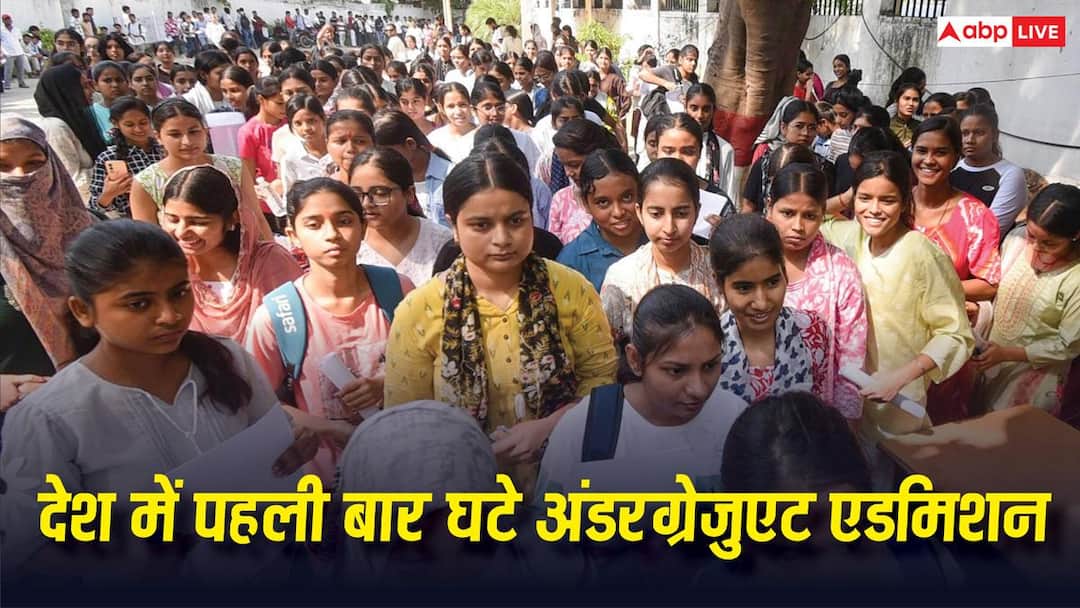

AISHE Report: For the first time, a new trend has emerged regarding higher education in the country. According to the All India Survey on Higher Education 2023-24 report released by the Ministry of Education, for the first time there has been a decline in the number of admissions in undergraduate courses in higher educational institutions across the country. On the other hand, the number of students in post graduate and PhD courses is continuously increasing. Experts believe that this change is not limited to statistics only, but the changing thinking of students towards higher education, increasing emphasis on vocational education and changing nature of population also indicate a crisis. In such a situation, let us now tell you why there is a decline in UG admissions in the country for the first time and what is its meaning.
What has come out in AISHE’s report?
According to AISHE reports for 2022-23 and 2023-24, the number of students taking admission in UG courses in 2023-24 decreased by about 1 lakh as compared to last year. However, there has been an increase in total higher education enrolment. While the total enrollment was 4.46 crore in 2022-23, it increased to 4.50 crore in 2023-24. During this period, the number of girl students also increased from 2.18 crore to 2.24 crore. At the same time, the gross enrollment ratio of the age group of 18 to 23 years also increased from 29.5 to 30.
Why did UG admissions decrease for the first time?
Experts say that there are many reasons behind this. According to former UGC Chairman Professor Sukhdev Thorat, skill-based education has been promoted at the school level under the new education policy. Now emphasis is being laid on vocational education from class 6 itself, due to which a large number of students are choosing skill-based options instead of traditional degree courses. He also said that changes like 4-year graduation course, multiple exit system and common university entrance test have also affected admissions. Due to multiple exit system, many students are leaving their studies with certificate or diploma even before completing the degree.
College fees and scholarship also became the reason
According to the report, experts say that in the last few years, closure of many scholarship schemes and reduction in government funding has also affected the students. Increasing financial pressure in public institutions has led to increase in fees, making it more difficult than before for the economically weaker sections to pursue higher education. According to Professor Thorat, students have also suffered losses due to closure of many schemes like National Talent Search Examination, Girls Incentive Scheme for Secondary Education, Begum Hazrat Mahal Scholarship and Maulana Azad National Fellowship. He believes that these changes are especially affecting the socially and economically weaker sections.
Read this also-Bullet Train Driver: Have a dream to drive a bullet train, how can one become a driver in India, what should be the qualification?
Changing thinking of youth is also a big reason
On AISHE’s report regarding lack of admission in undergraduate, Professor Furkan Qamar, former Vice Chancellor of Central University of Himachal Pradesh, says that now not only the policy is changing, but the thinking of the youth is also changing. According to him, the number of children studying in schools is decreasing because the youth population is declining. On the other hand, many students and their families are realizing that there is no guarantee of employment after higher education. He said that most of the higher educational institutes are in the private sector, where the fees are very high. In such a situation, many families are not able to provide expensive education to their children and students are turning towards alternative careers or skill development courses.
Education Loan Information:
Calculate Education Loan EMI
Be the first to read breaking news in Hindi aajsamacharindia.com| Today’s latest news, live news updates, read most reliable Hindi news website aajsamacharindia.com|
Like us on Facebook or follow us on Twitter for breaking news and live news updates.